TILA APR vs. Flat-Fee Cash Advance Benchmark
Under federal Truth in Lending Act (12 CFR § 1026.22) rules, a flat $15 fee per $100 borrowed over a 14-day pay cycle equals a 391.07% Annual Percentage Rate. Adjust the principal slider below to compare single-payment balloon payoff shock against amortizing federal credit union and installment alternatives.
Four Core Pillars of Responsible Small-Dollar Borrowing
Consumer credit contracts vary dramatically depending on state licensing, payment clearing rails, and repayment structure. Our research library equips households to audit every clause before executing an electronic promissory note.
1. Regulation Z TILA Disclosure Audit
Verify the segregated federal Truth in Lending box—Annual Percentage Rate, Finance Charge, Amount Financed, and Total of Payments—before providing any E-Sign signature.
Read Contract Audit Guide →2. 50-State Usury & Database Limits
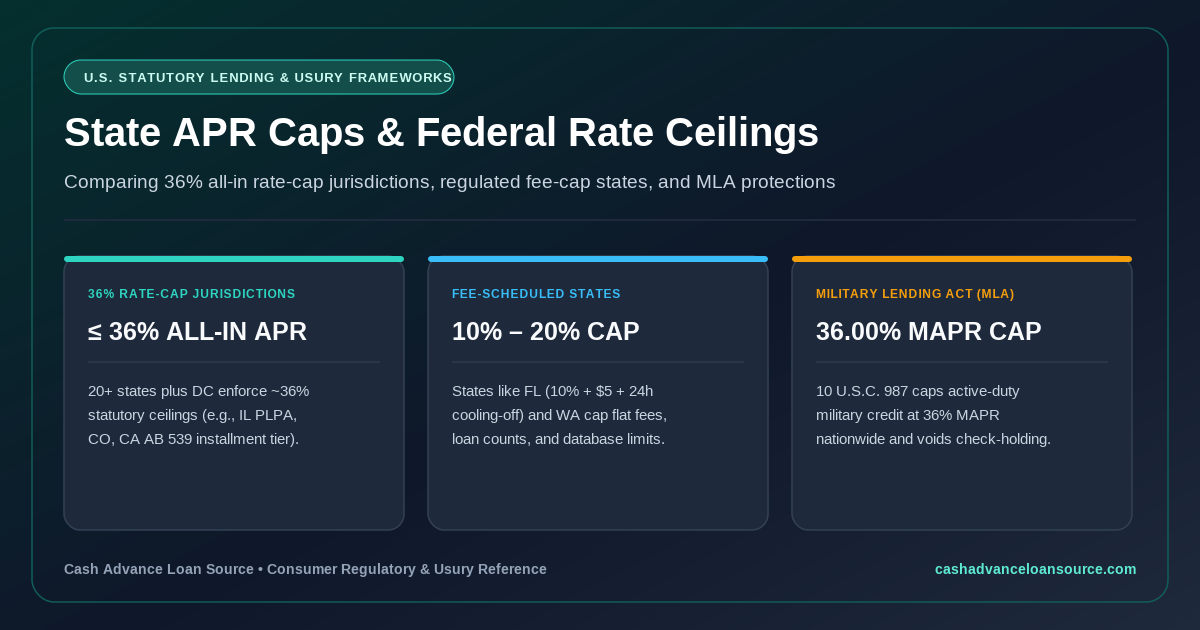
More than 20 states enforce ~36% APR ceilings, while database states like Florida, Michigan, and Washington block simultaneous loan stacking across lenders.
Explore State Rate Caps →3. Specialty Subprime Bureau Transparency
Understand how CoreLogic Teletrack, Experian Clarity, and Equifax DataX track short-term inquiries—and exercise your free annual FCRA file dispute rights.
Inspect CRA Underwriting →4. Statutory Rollover Exit Protections
Learn how to trigger $0-fee Extended Payment Plans (EPPs), issue Regulation E ACH stop-payment notices, and transition high-cost debt into nonprofit counseling.
Review Debt Exit Framework →How U.S. State & Federal Lending Regimes Regulate Short-Term Credit
| Regulatory Framework | Representative Jurisdictions | Typical Cost / APR Ceiling | Key Borrower Safeguard |
|---|---|---|---|
| Strict ~36% Usury Cap | CA, NY, IL, CO, MN, MA, CT, NJ, DC (20+ states) | 24% – 36% APR statutory max | Triple-digit balloon payday lending prohibited or strictly rate-capped. |
| Database Fee-Cap States | FL, WA, IN, MI, VA, KY, OK | $10 – $15 per $100 (260% – 391% APR) | Statewide Veritec database blocks loan stacking; mandatory cooling-off & EPP rules. |
| CAB / Permissive States | TX (Ch. 393 CAB), UT, NV, ID | Uncapped broker/lender fees (400%+ APR) | Municipal ordinances (e.g., Austin, Dallas, Houston) cap loans at 20% gross monthly income. |
| Federal MLA & NCUA PAL II | Nationwide (Active Military & Federal Credit Unions) | 36% MAPR (MLA) / 28% APR (PAL II) | Bans rollovers, check-holding, and forced arbitration for covered servicemembers. |
Featured Consumer Lending & APR Research Guides
View All 48 Guides →Consumer Guide to Cash Advance Structures: Permissive vs. Rate-Capped States, Fee Math & Exit Rights
Master the essentials of cash advance structures across rate-capped and fee-scheduled states, including APR cost formulas, database limits, and exits.
Verifying Online Lender Legitimacy: State NMLS Lookups, Sovereign Immunity Risks & GLBA Security
Learn how to verify online lender licensing via NMLS Consumer Access, identify sovereign-immunity choice-of-law clauses, and check GLBA data encryption.
Pre-Signing Checklist for Emergency Cash Loans: Auditing TILA Disclosures, ACH Clauses & Prepayment
Explore our 7-point pre-signing loan audit guide to inspect Truth in Lending boxes, daily simple-interest accrual, ACH clauses, and prepayment terms.
Short-Term Loan Eligibility & Ability-to-Repay Rules: Income Verification, Benefits & Debt Ratios
Review short-term loan eligibility rules covering W-2 and Social Security income verification, state gross-income caps, and residual budget benchmarks.
Same-Day Emergency Cash Comparison: FedNow Rails, Earned Wage Access & Debit Push Fee Traps
Compare rapid emergency funding options including Earned Wage Access, FedNow instant rails, and Visa Direct push-to-card while avoiding expedite fee traps.
Emergency Household Liquidity Economics: Weighing NSF & Utility Shutoff Penalties Against Loan Fees
Explore household emergency liquidity analysis comparing bank NSF cascades, utility reconnection fees, and late-rent penalties against short-term credit.